
Treating mCRC with FRUZAQLA® (fruquintinib) could make a real difference. Here's how:
Chemo-free FRUZAQLA offers a convenient 3L+ treatment option with once-daily oral dosing.1-3
FRUZAQLA could help close critical treatment gaps for patients with previously treated mCRC.1,4-6


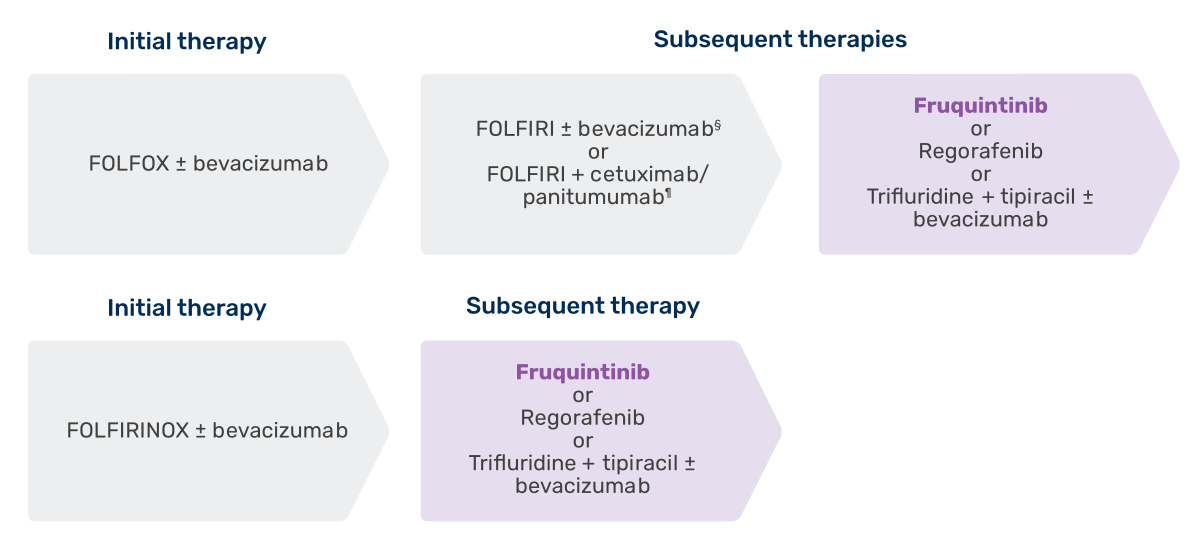
National Comprehensive Cancer Network® (NCCN®) recommends fruquintinib (FRUZAQLA) as a potential treatment option for patients with previously treated mCRC post exposure to oxaliplatin- and irinotecan-based regimens, regardless of mutation status10,11
Fruquintinib (FRUZAQLA) is indicated for the treatment of adult patients with metastatic colorectal cancer (mCRC), also known as stage 4 colorectal cancer, who have been previously treated with fluoropyrimidine-, oxaliplatin-, and irinotecan- based chemotherapy, an anti-VEGF therapy, and, if RAS wild-type and medically appropriate, an anti-EGFR therapy.1
Potential treatment algorithms*†‡
aCoverage relevant to your patients may vary and is subject to change without notice. Status is representative of the coverage for the majority of members covered under each plan. This information is not intended to give advice or promise coverage or payment. Contact the plan for more information about current coverage, restrictions, or requirements that may apply.
*Other permutations and combinations are also recommended in NCCN guidelines.
†These examples are for BRAF and HER2 wild type, pMMR/MSS, and NTRK gene fusion—negative disease, unless otherwise noted.9,10
‡Please see NCCN Guideline for Colon or Rectal Cancer for full recommendations.
§If RAS mutant.
¶If RAS wild type.
3L+=third-line plus; FOLFIRI=leucovorin, fluorouracil, and irinotecan; FOLFIRINOX=leucovorin, fluorouracil, oxaliplatin, and irinotecan; FOLFOX=leucovorin, fluorouracil, and oxaliplatin; HER2=human epidermal growth factor receptor 2; mCRC= metastatic colorectal cancer; MSS=microsatellite stable; pMMR=proficient mismatch repair.
Adapted with permission from the NCCN Clinical Practice Guidelines in Oncology (NCCN Guidelines®) for Colon Cancer V.2.2026. © 2026 National Comprehensive Cancer Network, Inc. All rights reserved. The NCCN Guidelines® and illustrations herein may not be reproduced in any form for any purpose without the express written permission of NCCN. To view the most recent and complete version of the NCCN Guidelines, go online to NCCN.org. The NCCN Guidelines are a work in progress that may be refined as often as new significant data becomes available.
Adapted with permission from the NCCN Clinical Practice Guidelines in Oncology (NCCN Guidelines®) for Rectal Cancer V.2.2026. © 2026 National Comprehensive Cancer Network, Inc. All rights reserved. The NCCN Guidelines® and illustrations herein may not be reproduced in any form for any purpose without the express written permission of NCCN. To view the most recent and complete version of the NCCN Guidelines, go online to NCCN.org. The NCCN Guidelines are a work in progress that may be refined as often as new significant data becomes available.
NCCN makes no warranties of any kind whatsoever regarding their content, use or application and disclaims any responsibility for their application or use in any way.
Clinical results with FRUZAQLA
Learn about the efficacy results from the FRESCO and FRESCO-2 studies in patients with previously treated mCRC.
FRUZAQLA patient profiles
Learn about patient types and why they may benefit from FRUZAQLA.