FRESCO-2 STUDY DESIGN
FRESCO-2 was a global, randomized, double-blind, multicenter phase 3 study1,3
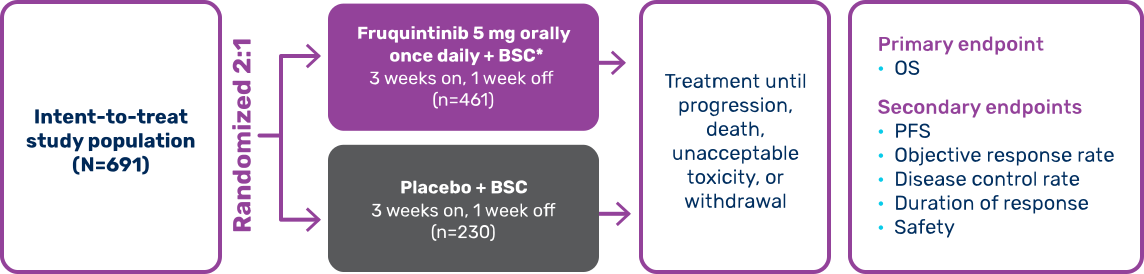
Inclusion criteria1,3
- ECOG PS 0‑1
- Progression during or after prior treatment with fluoropyrimidine‑, oxaliplatin‑, or irinotecan‑based chemotherapy, an anti‑VEGF biological therapy, and, if RAS wild type, an anti‑EGFR biological therapy
- Progression during or after prior treatment with trifluridine‑tipiracil, regorafenib, or both
Stratification3
- Prior therapy (trifluridine‑tipiracil vs regorafenib vs trifluridine‑tipiracil and regorafenib)†
- RAS mutational status (wild type vs mutant)
- Duration of metastatic disease (≤18 months vs >18 months)
*Best supportive care was determined by local clinical practice.3
†To prevent unintentional enrichment, the number of patients previously treated with regorafenib was limited to 50% of the total randomly assigned patients.3
BSC=best supportive care; mCRC=metastatic colorectal cancer.
FRUZAQLA was studied in a robust clinical trial that included a heterogeneous patient population1,3,4
FRESCO-2 patient characteristics1,3

aLower quartile/25th percentile–upper quartile/75th percentile.4
bECOG PS scores range from 0 to 5, with 0 indicating fully active and higher scores indicating greater disability.3
cDuration of metastatic disease=(date of randomization – date of diagnosis of metastatic disease)/30.4375.3
FRESCO-2 OVERALL SURVIVAL
Meaningful Time: In a study of FRUZAQLA+ BSC placebo+ BSC in patients with previously treated mCRC, FRUZAQLA demonstrated a significant nearly 3-month improvement in median OS.1
OS in patients with previously treated mCRC

- Early and rapid separation of OS curve evident at Month 11
CI=confidence interval; HR=hazard ratio.

OS benefit was consistent across most prespecified subgroups3
Results seen regardless of duration of metastatic disease, RAS status, prior types of therapy, and presence of liver metastases3

The FRESCO-2 study was not powered to show significance in OS across these specified groups.
FRESCO-2 DISEASE CONTROL
FRUZAQLA demonstrated improved anti-tumor activity vs placebo1,3,5
Disease control rate was stable for more than half of patients treated with FRUZAQLA + BSC*1,3

This study was not powered to show significance in disease control rate.
*Disease control was defined as the proportion of patients with a best overall response of confirmed complete response, partial response, or stable disease for ≥7 weeks.3
†Includes patients who received study drug and had ≥1 post baseline scan.5
FRESCO-2 PROGRESSION-FREE SURVIVAL
In a study of FRUZAQLA + BSC vs placebo + BSC in patients with previously treated mCRC
FRUZAQLA more than doubled median progression-free survival1,3
PFS in patients with previously treated mCRC1,3

- Early and rapid separation of PFS curve evident at Month 11,3
In a study of FRUZAQLA + BSC vs placebo + BSC in patients with previously treated mCRC
PFS benefit was consistent across most prespecified subgroups3

The FRESCO-2 study was not powered to show significance in PFS across these specified groups.
BSC=best supportive care; CI=confidence interval; DCR=disease control rate; DoR=duration of response; ECOG PS=Eastern Cooperative Oncology Group performance status; EGFR=epidermal growth factor receptor; HR=hazard ratio; ORR=objective response rate; OS=overall survival; PFS=progression-free survival. RAS=rat sarcoma; VEGF=vascular endothelial growth factor.